My Latest Book Goes On Sale Today!
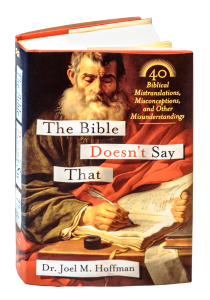 My latest book — The Bible Doesn’t Say That: 40 Biblical Mistranslations, Misconceptions, and Other Misunderstandings — goes on sale today!
Here’s the cover copy:
The Bible Doesn’t Say That explores what the Bible meant before it was misinterpreted over the past 2,000 years.
Acclaimed translator and biblical scholar Dr. Joel M. Hoffman walks the reader through dozens of mistranslations, misconceptions, and other misunderstandings about the Bible. In forty short, straightforward chapters, he covers morality, life-style, theology, and biblical imagery, including:
• The Bible doesn’t call homosexuality a sin, and it doesn’t advocate for the one-man-one-woman model of the family that has been dubbed “biblical.”
• The Bible’s famous “beat their swords into plowshares” is matched by the militaristic, “beat your plowshares into swords.”
• The often-cited New Testament quotation “God so loved the world” is a mistranslation, as are the titles “Son of Man” and “Son of God.”
• The Ten Commandments don’t prohibit killing or coveting.
What does the Bible say about violence? About the Rapture? About keeping kosher? About marriage and divorce? Hoffman provides answers to all of these and more, succinctly explaining how so many pivotal biblical answers came to be misunderstood.
The table of contents is on-line here, and you can learn more about the book here. Publishers Weekly has a pre-review here.
I’m excited about this latest work, and look forward to discussing it here.
Translating the Bible into a Language Whose Values you Hate?
Kate asks a fascinating question about translating the Bible into the language of an cannibalistic tribe in the Amazon that grammatically classifies non-tribe members as “edible”:
Linguist/philosopher Steven Pinker and other researchers inform us that the language of one Amazonian tribe, the Wari, grammatically classifies nouns as either “edible objects” or “inedible objects” — with the category of “edible objects” including all non-Wari human beings, while the category of “inedible objects” includes the Wari themselves. […]
The Bible translation conundrum which this situation creates is, plainly, this: How does one translate the Bible into Wari? […]
How, then, should the Bible be translated into a language whose very grammar endorses cannibalism of outsiders?
There are really two potential issues here.
The first concerns the grammatical details of Wari: What kind of marking is this? In particular, is it pro-forma (like “feminine” and “masculine” in, say, Greek) or is it semantic? If it’s pro-forma, then there’s no problem. (One way to test — are there any Wari speakers reading this? — is with a sentence like, “We can’t eat this meat because…” If “meat” in that sentence still takes the edible marking, as I suspect it would, then the marking is simply a matter of grammar, not of meaning.)
However, if the marking really only applies to things that can eaten, and if, in addition, it must be applied to foreigners, then we have a second issue: What do we do if we don’t like the values expressed by a language?
Wari (if our information is correct) isn’t the only language that might present this dilemma. What about a language that classifies women as children, for example? What about cultures in which a father takes the name of his firstborn child, but only if that child is a boy? And so on.
With Wari, the obvious temptation is to create a translation in which, say, Paul is neither edible nor a member of the Wari tribe. But that, apparently, would be ungrammatical, and, I think, representative of a common but hugely misguided approach to Bible translation: trying to convey more than we can. (This is, again, assuming our information about Wari is right.)
By analogy, we can imagine a language that divides nouns into “human” and “inanimate,” the way English does with “who” versus “that”: “This is the person who changed my life” versus “this is the idea that changed my life.” Hebrew doesn’t differentiate in this way. The question is what to do with “God.” Is God a person or an inanimate object? Hebrew doesn’t force the choice, but English does. Most translators opt for “who” here, not even noticing the way their choice narrows the meaning of the Hebrew. We could go with “that.” We could not, however, make up a new work in this context to convey are disapproval about the dichotomy in English.
Similarly, I think the way to translate the Bible into a language like Wari is to bite the bullet and use the “edible” marking, as the native speakers do, for anyone who’s not part of the tribe. It’s not just that our job, as translators, is not to judge (though I understand that, in practice, most people doing this kind of work are doing it precisely to judge those people and to change their ways.) Even more, we have no choice.
Such an interesting question. Thanks.
Introducing “The God Confusion”
 For some time now I’ve been variously confused, surprised, and even amused by the vehement if sometimes uninformed war of words between what I call the professional atheists and people who study religion and the Bible. To help sort things out, I’ve created “The God Confusion“:
Here’s an excerpt from the welcome post:
At a recent dinner I had with friends, an ardent atheist and a member of the clergy rehashed an argument that most of us are familiar with:
Believing in God is an inexcusable lapse — said one person — a blatant retreat from the obvious advances of science. So religion and God properly belong with superstition in the trash-heap of history.
The other countered that such a position is based on a naive misunderstanding of God and religion. There is no conflict between God and science, or between religion and modernity. It’s ignorance that makes some people think they have to choose.
The first person retorted that he knew exactly what God was. It was the clergy member, he said, who was trying to redefine God in a last-ditch effort to salvage religion.
And so it went: God isn’t a white-bearded magician in the sky. No, it’s worse: God is a vindictive and petty tyrant. God is the source of morality. Atheists don’t need God to be moral. That’s because atheists learned about morality from religion. Religion is the root of all evil. What about Stalin? There are evil priests, too. And on, and on.
I hope you’ll stop by and add your voice to the conversation.
New Evidence on Who Wrote the Bible, and When
From my personal blog, in response to new evidence about who was literate in ancient Jerusalem and when the Bible was written:
The world’s most popular piece of writing may have been written earlier than many people think. And it may have been more widely read…
Sometimes “Believing the Bible” Means Believing That a Story in it Didn’t Happen
Some stories in the Bible were meant to be history, others fiction. But modernity has obscured the original distinction between the two kinds of biblical writing, depriving readers of the depth of the text.
One way to understand the difference between history and fiction in the Bible is through the Old Testament’s natural division into three parts:
- The world and its nature (Adam to Terah).
- The Israelites and their purpose (Abraham to Moses).
- The Kingdom of Israel and life in Jerusalem (roughly from King David onward).
Even a cursory look reveals a clear and significant pattern.
In the first section, characters live many hundreds of years, and in the second, well into their second century. Only in the third section do biblical figures tend to live biologically reasonable lives.
For example, Adam, in the first section, lives to the symbolic age of 930, and Noah lives even twenty years longer than that. Abraham, from the second section, lives to be 175, his son Issac to 180, and Jacob “dies young” at the age of 147. But the lifespans from King David onward, in the third section, are in line with generally accepted human biology.
Furthermore, historians mostly agree that only the third section represents actual history.
The reasonable ages in the third section of the Bible, and, in particular, the wildly exaggerated ages in the first, suggest that the authors of the Old Testament intended only the third part as history. Underscoring this crucial difference, some of the lifespans in the first two sections are so absurd as to defy literal interpretation. These hugely advanced ages are central clues about the point of the stories. Continue reading
Genesis 2:18 and Homosexuality
Genesis 2:18 sets the stage for (one account of) Eve’s creation. God declares that “it is not good for the man to be alone,” which is why God decides to make, as the NRSV translates, a “helper suitable for him”: Eve.
Because Adam and Eve are the paradigmatic married couple in the Bible — and more generally, because we are all Adam and Eve — one interpretation of this arrangement in Genesis is that men should only marry women and women men.
Buttressing this claim is an often-cited alternative translation for the Hebrew word k’negdo. While the NRSV renders this as “suitable,” some others focus on the root of the word, neged, and translate the word as “opposite” or “complementing.” If so, Eve’s purpose was to be different than Adam. More generally, a man’s spouse is supposed to be different than him, that is, a woman.
As it happens, k’negdo doesn’t mean “different than him.” It means “matching.” One way to match things is pairing things that are opposite, but certainly it’s not the only way. In spite of this nuance, however, the complementarian interpretation of Genesis is reasonable.
But it’s not the only reasonable interpretation.
It’s just as reasonable to focus on the point of Eve’s creation, namely, that Adam shouldn’t be alone. More generally, people shouldn’t be alone. If it then turns out — as certainly seems to be the case — that some men can only find partnership with other men and that some women can only find partnership with other women, then Genesis 2 might not only allow homosexual marriage but, in fact, demand it.
In other words, one way of looking at Genesis 2 is that people should behave like Adam and Eve, a man marrying a woman and woman marrying a man. Another equally valid way is that people should behave like Adam and Eve, finding a partner so they are not alone.
Why is There No Heartbreak in the Bible?
There doesn’t seem to be any heartbreak in the Bible, at least not romantic heartbreak. In light of how popular that theme is in popular culture, we have to wonder why, particularly because the Bible is largely about the human condition. Why is such a common emotion lacking from the Bible?
Other interpersonal sorrows feature prominently: sibling rivalry, marital strife, barrenness, jealousy, and murder. And biblical characters lament the death of their parents, their children, and their spouses. But where is unrequited love?
Some passages seem tangentially related. James 4:2, for instance, may come close: “You covet but cannot have, so you fight” — if “so” is the correct interpretation here. The famous passage about love in 1 Corinthians 13 might be re-purposed as relationship advice, and so might 1 John 4:7-8 (“whoever does not love does not know God”). Proverbs 13:12 acknowledges that “hope deferred makes the heart sick.”
But why aren’t there any stories about the acute agony of a broken heart?
What do you think?
Off Topic: How I Spent My Summer Vacation
I had the great fortune this summer to speak in three cities in South Africa, and I’m blogging about what I saw — both the politics and the exquisite nature — on my fiction author site.
I just wrote about my first day of safari:
The setting was incredible. Pockets of small green trees punctuated vast expanses of golden grass beneath cloud-streaked blue skies. If serenity and awe had a visual representation, this was surely it.Rhino in Pilanesberg

“What,” I asked them, “should I know about South Africa that I’m unlikely to see on my own?” I followed up with, “what would I see I could leave my bubble?”Students Watch Performers in Soweto
There were some language barriers. But I could be patient.

What’s This Leaping in Luke 1:41?
According to the NRSV translation of Luke 1:41, Elizabeth’s “child leaped in her womb.”
The Greek here for “womb” (koilia) means “belly” or “stomach.” It’s the same word used of the snake in Genesis, for instance, which is punished to walk on its belly. Because snakes don’t have wombs, contexts like this show us that the Greek word is more general than “womb.” But “womb” is still a reasonable translation. And certainly we know that the “child” was in the womb, not some other part of Elizabeth’s anatomy, even if the original text was less clear.
The “child” here (brefos) probably refers literally to what we might now call an infant. But, like the (well accepted) shift from “stomach” to “womb,” I think we should translate this as “fetus.” Even if I’m wrong, though, I don’t think this word has much to do with the status of a fetus, for reasons I’ve already pointed out — in particular, the general way in which words are disconnected from the time at which they apply. (This is why the “child” in a woman’s womb in Leviticus similarly doesn’t tell us about the status of a fetus.)
What about the leaping? What was this child or infant or fetus doing?
The Greek is skirtao, and here we find a surprise. That Greek verb is used elsewhere almost entirely in two (related?) contexts: figuratively, and of fetuses.
In Genesis 25:22, Rebekka’s twin children “struggled together within her.” That’s skirtao.
In Psalm 114 (verses 4 and 6), mountains “skip”; in Wisdom 17:19, animals whose running is invisible “leap”; in Malachi 3:20, those who revere God’s name shall “leap” like calves; in Jeremiah, plunderers “frisk about” like a cow; and in Luke 6:23, God’s chosen should rejoice and “leap for joy.” All of those are skirtao in Greek. (Joel 1:17 uses the verb, too, but in a translation that doesn’t accord perfectly with the original text.)
So it looks like “leap” is only one possible translation, and probably not even the best. Perhaps “moved in the way that fetuses do” would be better. Or maybe “leaped for joy” in the same metaphoric sense of the English phrase, which indicates joy but not necessarily actual leaping.
One thing is certain, though. If we go with the NRSV translation of “leap,” we must understand the language figuratively. While fetuses can shift, kick, and otherwise move, actual physical leaping is beyond their ability.
About

God Didn’t Say That (@GodDidntSayThat) is an online forum for discussing the Bible and its translations, mistranslations, interpretations, and misinterpretations.
Dr. Joel M. Hoffman is the chief translator for the ten-volume series My People’s Prayer Book, author of And God Said: How Translations Conceal the Bible’s Original Meaning, and editor of The Unabridged Bible. Writing under “J.M. Hoffman,” he is author of the thriller series The Warwick Files. He holds a PhD in theoretical linguistics and has taught at Brandeis University and HUC-JIR in New York City. He presents widely to churches, synagogues, and other groups. more…
Have a question or a topic you’d like addressed? Click on “About” here or to the far upper right and leave a comment.
Of Note
Recent Comments


My Fiction
My thriller series: The Warwick Files.
"A police chief with a secretive past. A quiet New York City suburb. And, officially, no spies."Watch the trailer: 

 God Didn't Say That